
COMMENTARY | November 9, 2026
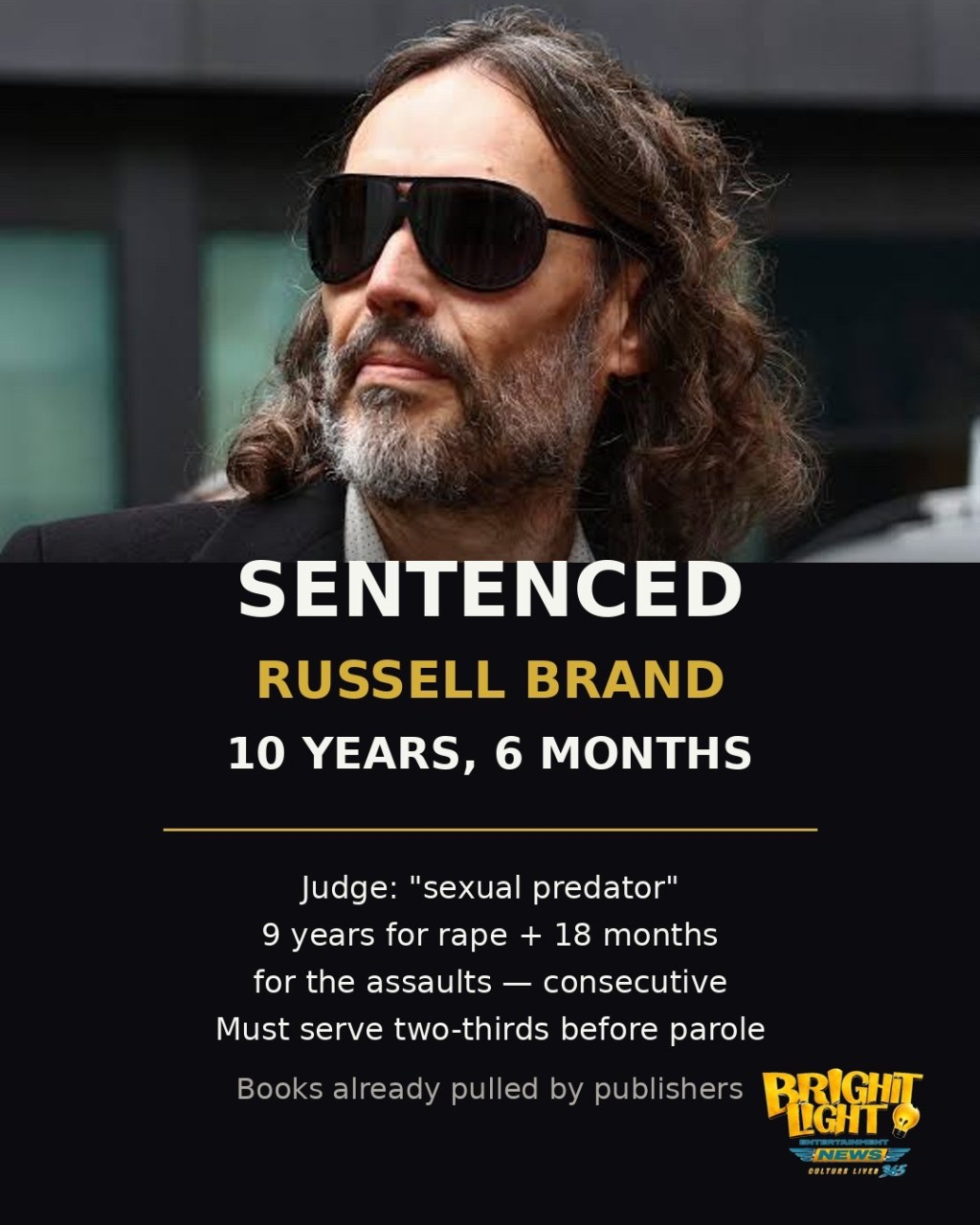
Russell Brand was sentenced to 10 years and six months in prison on Monday, November 9, at London’s Southwark Crown Court. A jury convicted him on November 5 of one count of rape and three counts of sexual assault involving four women. Victim impact statements from all four women were heard at sentencing, and Brand will be on the sex offenders’ register for life. Metropolitan Police
Judge Joel Bennathan imposed nine years for rape. The three sexual assault terms run at the same time as each other, with the longest term of 18 months added after the rape sentence. Brand will serve two-thirds of the total before release on licence, which means he can be returned to prison if he breaks its conditions. Bennathan called Brand a “sexual predator” during sentencing. Reuters court footage · Associated Press
Jurors acquitted Brand on two other rape charges and one charge of attempted indecent assault. Brand denied the charges and maintained his encounters were consensual. BrightLight365’s verdict coverage
The prison sentence follows decisions by British publishers to withdraw several of Brand’s books. Those decisions raise a wider question for the entertainment business. How closely do companies examine their own handling of complaints after a celebrity is convicted?
The publishing fallout
Pan Macmillan confirmed that it is withdrawing Brand’s books following his conviction. The affected titles include Recovery and Mentors. The publisher acknowledged those who came forward and the people harmed.
The Guardian reports that Hodder & Stoughton also withdrew Brand’s books, including his memoir My Booky Wook. Waterstones removed the affected listings and said it would return its remaining shop copies.
Those are commercial decisions following a criminal verdict. They do not answer whether the organizations surrounding a star recognized warning signs, handled complaints responsibly or placed revenue above people. Those questions require evidence about each institution’s conduct.
Across music and film, the outcomes are different
R. Kelly’s case shows that abuse can involve more than the performer at the center. His federal racketeering prosecution examined a structure that helped sustain his crimes. He received a 30-year sentence in 2022. The broader lesson is that investigators must follow the conduct of facilitators as well as celebrities.
Harvey Weinstein’s prosecution illustrates another reality: accountability can take years and survive reversals, retrials and continuing disputes. After his original New York conviction was overturned, he was convicted at retrial of sexually assaulting Miriam Haley and sentenced to 15 years in September 2026.
Sean “Diddy” Combs’ case must be described precisely. He was acquitted of racketeering conspiracy and sex-trafficking charges, convicted on two transportation-for-prostitution counts, and sentenced to 50 months in October 2025. Public accusations and the offenses established by a jury are different things.
These cases do not establish one shared entertainment conspiracy. They do justify scrutiny across the business: music companies, studios, publishers, agents and anyone whose actions may have enabled abuse or discouraged reporting.
Epstein: a proven conspiracy and unresolved public distrust
The Epstein case involved an actual criminal conspiracy. Ghislaine Maxwell was convicted of helping Epstein abuse minors and sentenced to 20 years in 2022. That finding is different from theories alleging that every prominent person associated with Epstein participated in his crimes.
DOJ announced in January 2026 that its released material totaled nearly 3.5 million pages. It also warned that the collection included material submitted by the public that could be false. A name in a document, an address book entry, a photograph or a flight record does not, by itself, establish a crime.
That distinction should protect accurate reporting, not end scrutiny. The legitimate questions concern what evidence was corroborated, what investigative steps followed, who made charging decisions and how those decisions can be independently reviewed.
What about government accountability?
The strongest documented example is the handling of Epstein’s earlier Florida investigation. A 2020 DOJ review found that then-U.S. Attorney Alexander Acosta exercised poor judgment in resolving the investigation through a non-prosecution agreement and in failing to ensure victims were notified of the state plea hearing. The review did not find professional misconduct.
That leaves a serious public-interest question: when an official decision fails victims, what consequences follow, and who decides whether those consequences are sufficient? An internal finding of poor judgment is not a criminal conviction. It also does not make the underlying failure unimportant.
Saying that no one in government is facing accountability would require a comprehensive, current accounting that the records reviewed for this article do not establish. Nor does the absence of a prosecution prove a cover-up. But the public is entitled to demand a clear explanation of the decisions, evidence and institutional failures surrounding Epstein.
America’s legal system must earn public trust
Criminal charges require evidence against identifiable individuals. Prosecutors should not lower that standard for famous defendants, political officials or people condemned online. The same principle demands that wealth, office and connections never become reasons to avoid a supported investigation.
Our position is straightforward: investigate credible evidence wherever it leads, explain consequential failures, protect survivors and make institutional accountability visible. Removing books addresses a publisher’s relationship with an author. It cannot substitute for examining who enabled harm, who ignored it and whether public institutions did their jobs.
We shine our Bright Light on it! 💡
Editorial note: This article combines sourced reporting with commentary. The cases discussed are separate; no shared conspiracy between their defendants is alleged. The sentencing update is current as of November 9, 2026.


Leave a Reply